

As large-model deployment moves into more demanding stages, more enterprises are abandoning the idea that “one model can handle everything” and building heterogeneous model pools combining full-capability flagship models with lightweight 8B, 27B and 35B models. Yet more models bring new problems: relying entirely on people to select a model from a dropdown is simply unmanageable.
For convenience, business users habitually choose the most expensive full-capability model, whether they are looking up a policy or writing code. Simple questions end up occupying high-end accelerators, requests queue up during business peaks, and genuinely high-priority coding and reasoning tasks time out. Compute bills remain high, while users are still dissatisfied.
Rise Router provides a unified entry point for multi-model calls. Requests matching a model-selection policy can select candidate models based on task text and administrator-configured descriptions of model capabilities, reducing the use of high-capability models for requests suitable for lightweight alternatives.
01 A Common Industry Pain Point: The Same Keywords Can Hide Very Different Tasks
One of the easiest mistakes in private multi-model deployments is being misled by superficially similar inputs.
The same word, “reimbursement,” can represent two entirely different AI tasks:
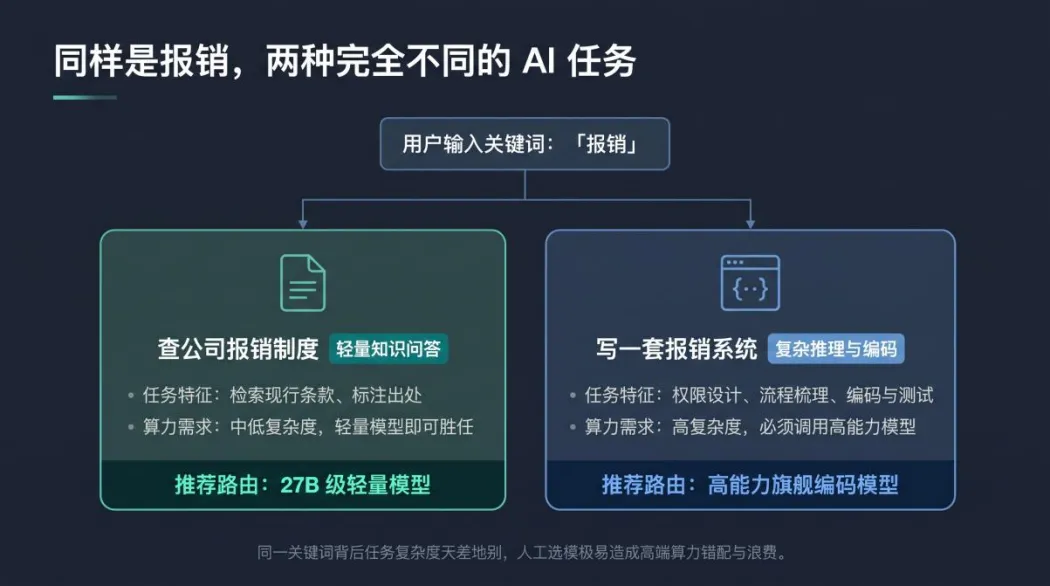
Figure: The same keywords can represent completely different AI tasks
-
Look up the company’s reimbursement policy: this is essentially knowledge-base question answering. The model only needs to retrieve current provisions, summarize the answer and cite its sources. A lightweight model can deliver high quality with low latency.
-
Write a reimbursement system: this involves permission design, approval workflows, coding and testing. It demands strong logical reasoning and coding capabilities and requires a flagship model with strong programming skills.
The instructions share almost the same keywords, yet their compute requirements and quality thresholds are vastly different. Research indicates that more than half of large-model requests in many enterprises could in fact be handled by small or medium-sized models, but continue to waste high-end compute on full-capability models, squeezing the service capacity available to core business workloads.
Leaving model selection to frontline business users amounts to asking human judgment to contend with engineering complexity—one of the biggest obstacles to deploying private AI at scale.
02 The Solution: Rules First, Semantics as a Fallback—Rise Router Builds an Enterprise Scheduling Layer
Rise Router provides a unified access point between business applications and model services. In the AI gateway’s Routing Policies section, platform administrators configure candidate models, their applicable scenarios, a decision service and a fallback model. Applications access the configured route through an OpenAI-compatible interface and supply the agreed model name, such as auto, in their requests. Applications can continue using the same entry point when administrators change the candidate models or selection policy.
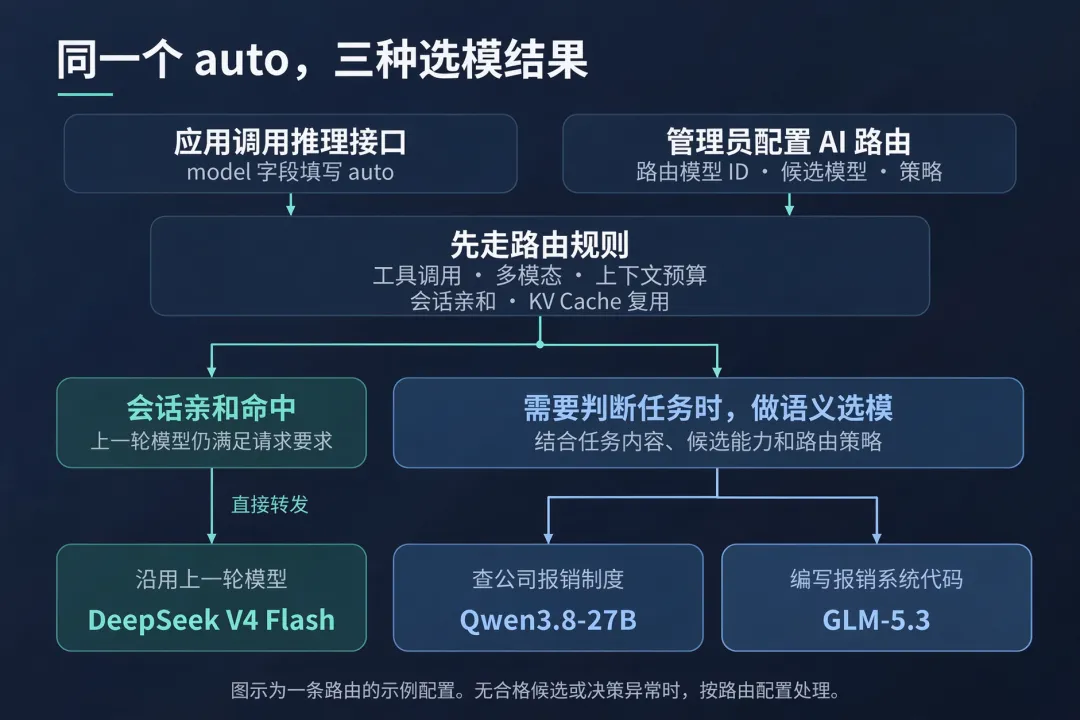
Figure: Layered model-selection execution for Rise Router’s auto route
Rise Router addresses two questions enterprise architects frequently ask through trigger conditions, decision timeouts, fallback configuration and authorization on the target route.
1. Will intelligent routing slow down responses?
The gateway first matches an AI route using conditions such as the domain, path, request headers and model name. Model selection starts only when a request matches a route with model decision-making enabled and the model name matches the trigger configuration. This policy is not triggered when an application directly specifies another model.
Once model selection begins, the gateway extracts the task text from the request and sends it, together with descriptions of the candidate models’ capabilities, to a registered decision service. This adds the overhead of calling that service. Administrators can configure a decision timeout to limit how long each call waits.
2. What happens if the wrong model is selected, or the caller lacks access to the target model?
The decision service selects from the administrator-configured candidates. The gateway validates the result, writes the selected model name into the request, and lets the target AI route perform authorization, model mapping and upstream forwarding. If the decision service fails, times out, returns an invalid result or produces confidence below the threshold, the gateway uses the preset fallback model. Both selected and fallback models remain subject to authorization on the target route. Enterprises can validate selection quality using representative tasks, then adjust model capability descriptions and confidence thresholds accordingly.
Returning to the reimbursement example, administrators can place a lightweight model suited to policy questions and a high-capability model suited to code generation in the same candidate set. Both “look up travel reimbursement standards” and “design and implement a reimbursement approval system” can go to the same auto entry point. Based on the task text and candidate capability descriptions, the first type of request can be assigned to the lightweight model and the second to the high-capability model. Business users simply describe the task, while administrators maintain model-selection policies centrally in the gateway.
03 Business and Technical Value: Supporting Private AI Delivery at Scale
When routing advances from simple forwarding to controlled intelligent scheduling, enterprises gain more than savings on a few accelerators: they gain the ability to deliver private AI services at scale.
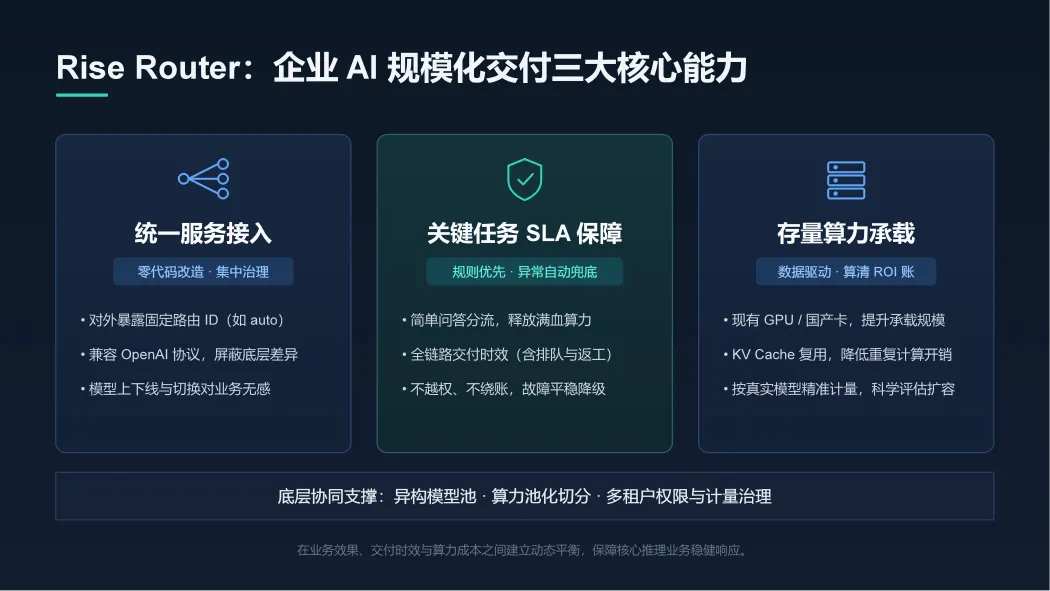
Figure: Three capabilities Rise Router brings to enterprise AI delivery at scale
- Unified service access reduces multi-model governance and integration costs Applications connect only to a fixed route ID. Model upgrades, additions, retirement and policy changes are handled centrally at the routing layer, without application code changes. This reduces repeated integration work and modifications caused by model version changes, lowering the maintenance burden of enterprise multi-model architectures.
- Protect core business delivery SLAs and distinguish business priorities Routine question-answering requests are directed to lightweight models, freeing full-capability model resources for coding, complex reasoning and core Agent workloads. More importantly, Rise Router considers model selection, queuing, retries and rework together in delivery time, rather than focusing only on the cost of an individual inference. This avoids hidden losses from repeated follow-up questions and reruns when a task is assigned to an unsuitable smaller model, balancing responsiveness for routine tasks with delivery quality for critical work.
- Make better use of existing compute and improve AI return on investment On existing private GPU hardware, intelligent model selection through Rise Router can increase the overall workload capacity compared with forcing every request onto a full-capability model. Combined with the gateway’s precise metering and operational dashboards, enterprises can calculate returns by department, scenario and actual model used. Look at the data before expanding capacity, and find a practical balance among business results, delivery time and compute costs.
To learn about Rise Router’s intelligent model-routing architecture or evaluate the ROI of multi-model traffic distribution on your existing cluster, call 400-605-2336 to contact RiseUnion’s consulting team.
END
About RiseUnion
Beijing RiseUnion Technology Co., Ltd. (RiseUnion) is a software provider with full-stack compute infrastructure service capabilities. Through a unified AI compute management platform, it offers an end-to-end solution for GPU cluster scheduling, large-model training and inference services, cloud-edge collaboration and compute operations. It has completed compatibility certification with more than 10 domestic chip vendors and has partnered with 4Paradigm to open-source ModelSphere, an adaptive large-model inference infrastructure platform. RiseUnion is recognized as a national high-tech enterprise and a Beijing specialized and innovative SME, and leads the AIIC Compute Resource Pooling Working Group. It has achieved large-scale production deployments in finance, government and enterprise, defense, transportation, healthcare and other industries.
RiseUnion is committed to making compute as readily available as water and electricity, building an intelligent, controllable and efficient computing foundation for enterprise AI transformation.
For more information, visit riseunion.ai or call 400-605-2336.