
Inference service performance is determined by the combined effects of the model, hardware and business workload. Longer contexts increase computation and cache pressure, while multi-turn Agent calls expand individual requests into continuous inference chains, affecting service latency. Model upgrades, hardware changes and traffic shifts can also invalidate existing configurations, requiring enterprises to reassess parallelism, caching and scheduling strategies. Enterprises therefore need to continually balance service quality, responsiveness and cost.
ModelSphere aims to deliver an inference service platform that can be continuously optimized. Based on an enterprise’s existing compute resources and real business scenarios, it helps select suitable operating approaches and continually calibrates them using actual operational data, enabling inference services to adapt dynamically to changes in models, hardware and business needs.

01 Scenarios Keep Changing; One Configuration Cannot Cover Every Stage
When hardware changes, deployment conditions change. Eight accelerators in one server do not have the same communication conditions as eight spread across two servers. A different accelerator type also changes device memory, compute capability and software support. Existing configurations must be reassessed against actual resources to determine how compute should be organized.
When workloads change, optimization priorities change. Short question answering emphasizes prompt responses; long documents increase input-processing pressure; multi-turn conversations offer opportunities to reuse history; concentrated access tests capacity and queuing policies. Pilot configurations must be validated again against new request lengths, conversation patterns and concurrency levels.
When models change, adaptation must continue. New versions bring new capabilities but can also change engine support, resource requirements or interface behavior. Teams need to validate the functions their business uses and recheck service quality and operational performance.
Enterprises introduce new hardware, applications accept longer material, and teams also want to use newer models. The challenge of continuous operation is keeping the service useful after these changes.
02 Keep Matching the Operating Approach to Business Goals
An enterprise first needs to define what successful task completion means: whether answer quality is acceptable, how long users can wait and how much request volume the service must handle. These conditions then guide the choice of hardware use, model and configuration.
Employee-facing interactive services need to control both the wait before an answer begins and pauses during generation. Background batch jobs care more about how many acceptable tasks can be completed within a deadline. Failed retries, repeated computation and waits all increase task-completion costs. Deployment configuration, resource allocation and request scheduling must reflect these practical requirements.
Validating a deployment recipe in a customer’s environment requires tests using the actual hardware, network and business requests to establish whether previous experience applies. After the environment or workload changes, operational data should be used to reassess the original judgment.
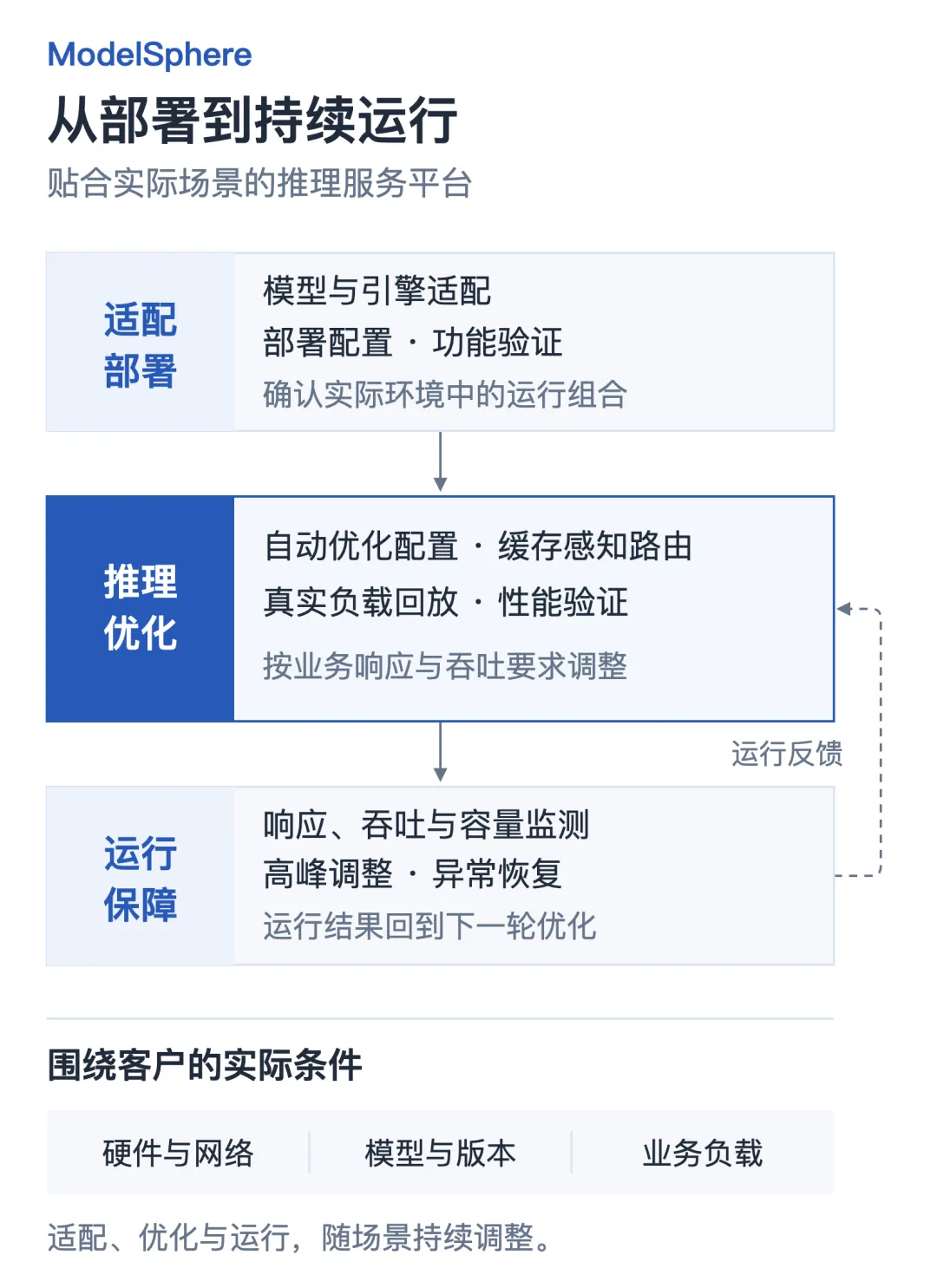
ModelSphere connects model adaptation, performance optimization and production operations. New model-hardware combinations require compatibility validation, while deployment and scheduling strategies need to match specific workloads. After launch, services still need adjustment for peaks, anomalies and performance changes. Each optimization retains its applicable versions, workload characteristics, configuration and test results, forming a validation baseline for the next upgrade or business change.
03 How Much Can Optimization Improve a Specific Scenario?
In a customer-side Ascend 910B4 long-context test, ModelSphere used eight cards in one server. Each request contained approximately 50,000 input Tokens and generated 1,500 output Tokens. The inputs had no reusable prefix cache.
Test scenario
One server with eight cards, long-context inputs
Corresponding improvement
Time to first Token fell from 363.3 seconds to 54.2 seconds
ModelSphere adjusted concurrency and cache capacity for this workload, reassessed the engine configuration for a single eight-card server, and optimized inter-card communication. The baseline and optimized configurations each ran at their own maximum supported concurrency under full load for 40 minutes, comparing their respective steady-state performance.
For long-document workloads, this reduced the wait before the answer began from about six minutes to less than one minute. The improvement came from adjustments specific to this hardware and long-context workload.
A separate multi-turn conversation test used two servers with 16 cards in total, each running an independent instance. Its 64 conversations comprised 1,088 requests with an average input of 34,380 Tokens, and concurrency was fixed at 128. Engine parameter tuning brought total throughput to 2.60 times the baseline; adding cache-aware routing then brought it to 1.82 times the tuned result.
The gains multiply across stages: 2.60 × 1.82 ≈ 4.73. The second stage uses parameter-tuned throughput as its baseline and multiplies it by another 1.82, ultimately reaching 4.73 times the original baseline.

Both tests used the DeepSeek-V4.1-Flash 910B4 (A2) deployment example configuration from the official vLLM Ascend documentation as their baseline, with necessary adaptations for this single-server eight-card instance. The original official example targets two servers with 16 global parallel units; this two-server test instead ran two independent eight-card instances. Hardware, container images and test workloads remained unchanged within each comparison.
Both tests used DeepSeek-V4.1-Flash with w4a8 quantization and vLLM Ascend 0.30.0rc2. Total throughput counts input and output Tokens together, and each test is compared with its own baseline.
Hardware will keep changing, models will be upgraded and businesses will continue to evolve. ModelSphere’s value lies in continually adapting, optimizing and operating services around these changes, enabling existing compute to keep providing stable, efficient inference.
END

ModelSphere is now officially open source on GitHub under the Apache 2.0 license. We want to share engineering experience gained from large financial institutions, centrally administered and other state-owned enterprises, and leading internet businesses with the wider open-source community and developers.
👉GitHub repository:
github.com/modelsphere/modelsphere
⭐️If ModelSphere’s design addresses your challenges, please give it a Star—your attention and Issue feedback help us keep improving.💬Want to evaluate deployment and optimization options for your business together? Start a discussion on GitHub or leave a message on our WeChat account.
About RiseUnion
Beijing RiseUnion Technology Co., Ltd. (RiseUnion) focuses on AI compute management and scheduling. It has completed compatibility certification with more than 10 domestic chip vendors and is a core contributor to the CNCF Sandbox project HAMi. The company is recognized as a national high-tech enterprise and a Beijing specialized and innovative SME, and leads the AIIC Compute Resource Pooling Working Group. It has achieved large-scale production deployments in finance, government and enterprise, defense, transportation, healthcare and other industries.
RiseUnion is committed to making compute as readily available as water and electricity, building an intelligent, controllable and efficient computing foundation for enterprise AI transformation.
For more information, visit riseunion.ai or call 400-605-2336.